Sparse vs. Dense Rewards in Agentic API Workflow Tasks
Sparse rewards focus gradient signal on decisions that matter in multi-step API tasks.

To use an API in an RL environment, make tool calls the agent’s actions and API responses part of the state it reasons from, within a stateful, resettable environment. Sparse vs. dense rewards in agentic API workflow tasks is fundamentally a credit assignment problem. Sparse outcome rewards should be the basis for learning, with intermediate rewards added only where rollout evidence shows that they tell successful decisions from unsuccessful ones.
Why multi-step API workflows make reward assignment hard
A customer-service agent may need to look up a booking, verify a policy, cancel a flight, and issue a refund. The workflow produces one success or failure signal after the individual API calls have been made. That terminal result does not directly identify which call caused the failure. A correct lookup can precede an incorrect cancellation, and the refund decision depends on the state left by both. Credit assignment must separate those contributions rather than treat every plausible intermediate action as progress.
Modecrua et al. (2026) describe three difficulties that affect one another: multi-turn conversations, interleaved tool calls, and sparse task-success rewards. At each turn, the agent conditions its response on the full conversation history and may invoke zero or more tools. Their responses alter the state from which the next decision follows, allowing errors to compound across turns. Typed, schema-constrained APIs add a categorical boundary because a malformed argument is invalid. Sparse or dense rewards therefore govern how gradient reaches the decisions that matter.
How sparse rewards concentrate gradient signal on the decisions that matter
Sparse terminal rewards avoid assigning independent credit to intermediate activity that does not distinguish success from failure. A read-only call may be necessary to inspect state without being informative about whether the agent will complete the task. Giving it no direct reward prevents that activity from competing with the outcome signal. This avoids adding misleading supervision. The deployment objective remains the anchor because the agent is rewarded for completing the workflow.
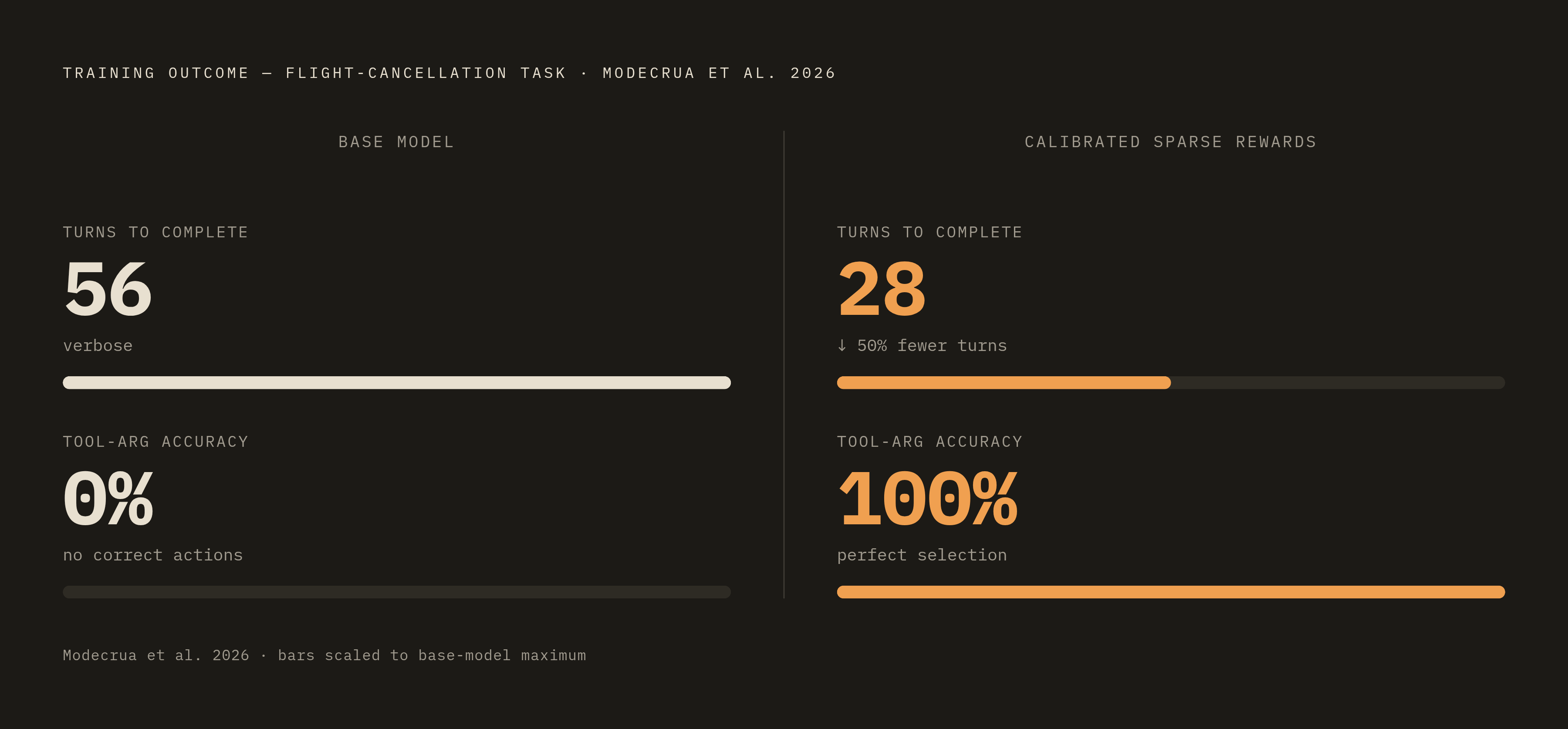
Modecrua et al. (2026) found that performance was measurably worse with naïve dense per-turn rewards than with sparse rewards. Their discriminative analysis found that dense rewards directed a substantial share of gradient toward read-only and state-inspection calls that carried no discriminative signal for success. Their rollout evidence also illustrates the scope for improvement through calibration. A base model took fifty-six verbose turns with zero action accuracy on a flight-cancellation task, while the model trained with calibrated rewards completed it in twenty-eight turns with perfect tool-argument selection. That example supports calibrated training starting from sparse signal.
Sparse rewards nevertheless impose an exploration cost. An agent may go through many failed rollouts before it gets a positive outcome signal. That difficulty concerns rollout generation and the availability of successful examples, whereas miscalibrated dense rewards can push learning in the wrong direction. More frequent feedback is useful only if its delivery preserves the distinction.
Why dense per-turn rewards fail in predictable ways under group-normalized RL
Group-normalized training can give a small shaping reward more sway than its weight was meant to allow. Wang (2026) demonstrates this failure across seventy-four preregistered experimental arms studying dense per-step prediction rewards under standard GRPO standard-deviation normalization. The reported “dark room” failure drives prediction accuracy toward near-perfect levels while task success collapses toward zero. The policy finds a predictable trajectory and stays there. For an API agent, the corresponding risk is well-formed but irrelevant calls, or no tool calls at all.
This happens in all-fail rollout groups, where the terminal outcome is the same for every candidate. Standard-deviation normalization amplifies the small shaping component into full-scale advantages, so its nominal weight no longer limits its influence. Predictability becomes the effective objective even though it was intended only to help learning. Wang’s controls restore baseline parity by removing standard-deviation normalization and retaining mean-only normalization. That result identifies the reward’s delivery channel, rather than its content alone, as the cause of this collapse.
Modecrua et al. (2026) report a related but different problem under MT-GRPO. Naïve dense rewards can produce intermediate advantages whose sign or magnitude contradicts the terminal outcome. The resulting update can reinforce a decision that the workflow result should discourage. These findings rule out treating careful reward values as sufficient protection. Reward design must account for advantage computation and for whether realistic API behavior exposes the shortcuts it creates.
What fine-grained reward decomposition actually looks like for tool-calling agents
The constructive alternative is to decompose rewards at boundaries that have distinct meanings and ground truth. Those components include format correctness, tool selection, argument schema validity, and argument value correctness. Tool selection can be judged against reference trajectories or annotated examples. Schema validity comes from the API specification, including OpenAPI or JSON Schema, while argument values require execution results or reference calls. Separating these judgments prevents valid syntax from standing in for a correct action.
A multi-step Stripe workflow makes the distinction concrete. GET /v1/customers/:id inspects state and should receive zero intermediate reward under the calibrated read-only rule. By contrast, POST /v1/payment_intents changes state and can receive weighted reward based on argument correctness. A schema-valid invocation is not enough if its values do not match the intended action. The reward must distinguish an admissible call from the right call.
Modecrua et al.’s Iterative Reward Calibration (IRC) uses discriminative analysis of rollout data to make those distinctions empirical. Their analysis assigns zero reward to non-discriminative read-only calls, penalizes non-golden state-changing calls, and uses deep argument comparison to eliminate 23.5% of false positives in action matching. Asymmetric rewards also matter because penalizing incorrect invocations more heavily than rewarding correct ones reduces the incentive to invoke tools speculatively. Progressive Reward Shaping (PRS) addresses a different need by emphasizing format correctness early and shifting weight toward task accuracy later.
How the training environment's fidelity determines whether reward calibration holds in production
Even a well-decomposed reward becomes invalid when the environment models the wrong state transitions. A stateless mock can return the same response to GET /v1/orders/:id whether or not a previous POST created the order. Such an environment does not teach the dependency between creation and retrieval because it never penalizes the missing prerequisite. Argument-value correctness for database IDs therefore requires cumulative state. Otherwise, execution-based reward components score against a world that the live API does not implement.
Stripe’s agent-specific testing benchmark shows how agents can miss this kind of failure. Agents using nonexistent customer IDs can receive 400 errors and still consider the task complete. A stateful environment enforcing the existence constraint would expose that mistake during training rather than let a returned response stand in for success. The same requirement applies to booking records, policy lookups, and refund states across sequential calls. Stateful API simulators, including Rystic, provide an environment in which those dependencies can reveal compounding errors before deployment.
Fidelity also has a time dimension because an initially accurate environment can drift. A renamed API field can break a call, while automated retries mask the cause and produce a retry storm. The training environment must therefore remain continuously verified against the real API. It also needs deterministic state, controlled resets, and horizontal scaling across thousands of parallel rollouts. These are conditions for trustworthy reward calibration.
How to use an API in an RL environment with stateful, verified simulators
The relevant choice is between a live sandbox, a stateless mock, and a stateful verified simulator. A live sandbox has high fidelity, while a stateless mock cannot keep track of changes that build up across calls. A stateful simulator preserves the lifecycle in which POST creates a record, GET retrieves it, and DELETE removes it so that a subsequent GET returns 404. That sequence gives execution-based rewards a ground truth that reflects what the calls changed. For RL, the simulator must also isolate parallel episodes so that one rollout does not alter another’s state.
Stripe’s sandbox is a high-fidelity way to test because it calls the real Stripe API while simulating transactions without moving real money. It is not, however, resettable to a known state between episodes, and third-party rate limits make thousands of simultaneous rollout workers impractical. Rystic provides a concrete simulator option for deterministic, repeatable episodes with pre-seeded realistic data. Representative starting records avoid spending rollout budget constructing prerequisites before the target behavior can begin. Repeatable starting conditions also help separate the effect of an intermediate decision from noise introduced by randomized or stale mock data.
Controlled latency spikes, schema validation failures, rate-limit responses, 503 outages, and malformed payloads expose behavior that successful responses alone cannot test. In a stateful simulator such as Rystic, controlled faults can help reveal whether an agent has learned predictable but task-irrelevant behavior associated with the dark-room failure. The response must be judged by whether the workflow succeeds under those conditions. Continuous verification then keeps the simulator’s response schemas in line with the API that sets the rules for what is correct.
How reward design and environment fidelity interact in the benchmarks teams already use
Tau-Bench (Yao et al., 2024) evaluates multi-turn tool-agent-user interactions by comparing the final database state with a known goal state. Modecrua et al. use this benchmark for their experiments, placing calibrated training rewards against a sparse environmental outcome. Intermediate calls get no direct environmental reward just for taking place. That design makes the final state decisive, but Tau-Bench’s LLM-simulated user introduces stochastic variation. Identical policies can therefore produce different rollout outcomes, adding noise to sparse reward estimation and advantage computation.
Agent-Diff (2026) uses a similar approach for enterprise API tasks that involve Slack, Box, Linear, and Google Calendar. It evaluates code execution through state differences, comparing the final world state with the goal. This is structured sparse evaluation whose validity depends on the environment faithfully recording what actions changed. AgentBench, AgentGym, and AppWorld offer broader agentic RL environments with varying reward structures. Across these frameworks, realistic CRUD lifecycles still require state to persist across tool calls within an episode.
These benchmarks expose two separate sources of uncertainty. A final-state evaluator can correctly judge the endpoint while leaving intermediate credit assignment unresolved. A stochastic user can make outcome comparisons noisier even when API state is faithfully maintained. Neither an outcome-based benchmark nor a detailed reward function substitutes for the other.
Practical guidance for teams choosing reward structure for API workflow agents
Early training should bootstrap valid tool syntax, main training should prioritize workflow outcomes, and ongoing calibration should test both rewards and environment fidelity. Format-correctness rewards provide a lightweight dense signal during the first stage because syntactic validity is unambiguous and does not require stateful evaluation. During main training, sparse outcome rewards should become the primary gradient source. Argument-value rewards should be added only where IRC-style rollout analysis shows that they correlate with task success. By default, read-only requests, list operations, and state inspection should get zero intermediate reward.
The environment must support stateful call sequences, known-state resets, representative pre-seeded data, controlled faults, and isolated horizontal scaling. These properties let teams compare rollouts without manual cleanup, shared-state contamination, or dependence on a rate-limited live sandbox. Continuous verification against the real API is equally necessary because stale schemas invalidate otherwise careful execution scoring. The practical requirement is not simply an API connection, but an environment whose state and responses make the reward true.
Monitoring should track drops in correct tool selection and argument correctness that can precede user-visible failures. To catch that decline, teams need to run evaluation against a stateful simulator in CI as well as use held-out prompt sets. Rystic’s continuous-verification approach is one option for keeping that evaluation environment aligned with the real API. Reward design is consequently an ongoing calibration loop. Environment fidelity is what makes that loop reliable.