Composing a Gym-Compatible RL Environment From a Third-Party API Contract Using Commercial Simulator State Authority
Wrap a third-party API in Gymnasium with a resettable local simulator.
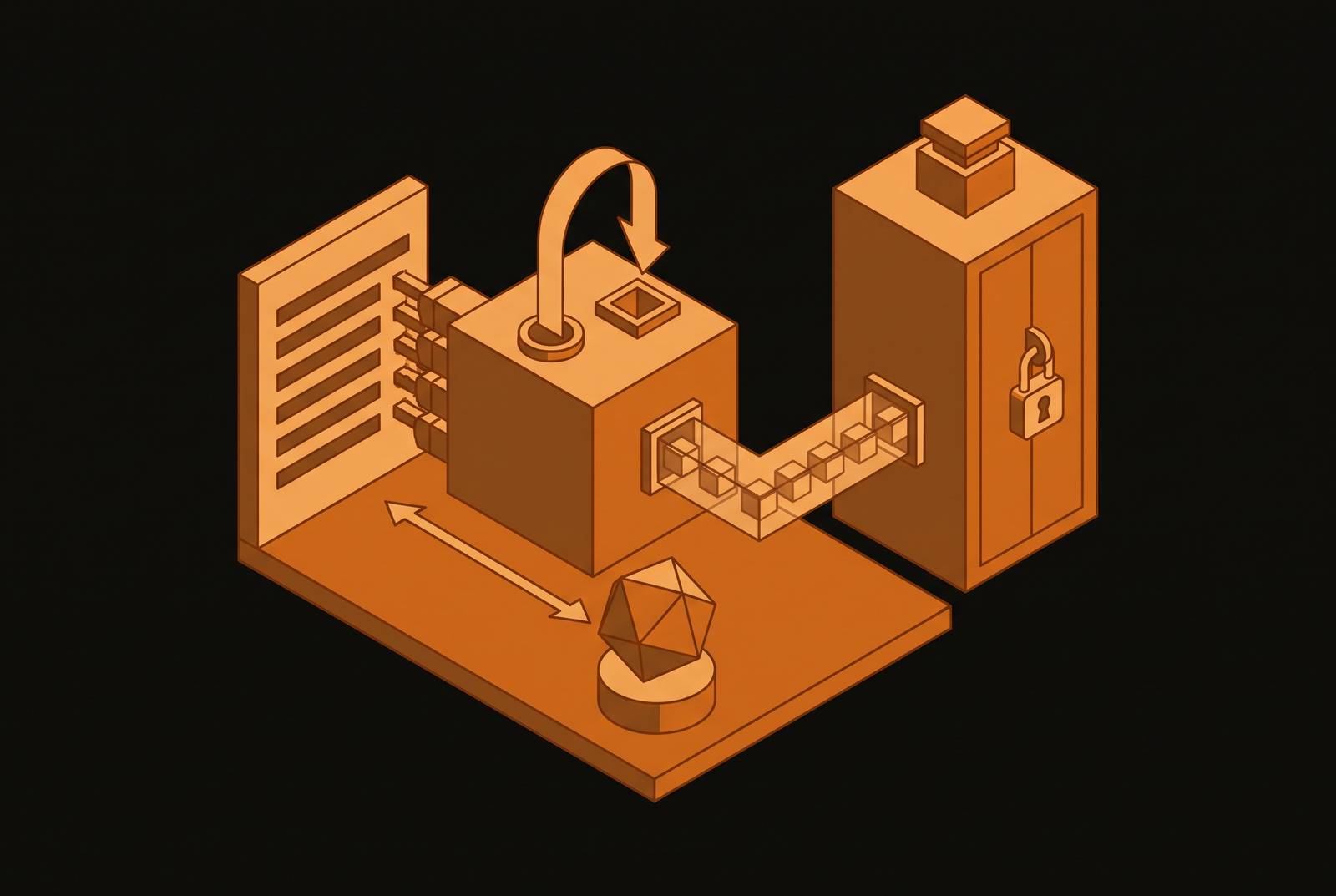
To use an API in an RL environment, wrap its contract in a Gymnasium environment backed by a local, stateful simulator. The wrapper translates observations and actions, while the simulator owns resource state and restores reproducible starting conditions. Authoritative, resettable state is the correctness condition that makes reset(), step(), rewards, and episode boundaries meaningful.
Why real commercial APIs cannot serve as RL training environments
RL training requires thousands to millions of interactions, with episodes that can be reset and replayed independently. Live APIs provide no such training boundary. Rate limits interrupt trajectories, credentials expose real services, and calls incur costs and side effects that cannot simply be rolled back. A POST /v1/orders used to train cancellation behavior creates a real record, leaving cleanup work that becomes impractical at training scale.
Stateless mocks remove those operational risks but discard the history the agent needs to learn from. Creating an order, retrieving it, and cancelling it requires the final call to know what the first call created. A fixed response discards that dependency and makes rewards gameable because apparent success need not correspond to any resource change. The required destination is a local stateful simulator that maintains a world model across calls and restores a known starting state on demand.
How do you wrap an external API as a Gymnasium environment?
Gymnasium defines the interface between that world model and the training algorithm. Its step(action) method returns (observation, reward, terminated, truncated, info), consisting of the next observation, a scalar reward, two true-or-false boundary flags, and a diagnostic dictionary. Its reset(seed, options) method returns (observation, info) from a fresh, reproducible starting state. These return structures are the contract that allows training libraries to consume the environment.
The wrapper must also declare observation_space and action_space using typed space objects such as Box, Discrete, or Dict. Each observation that is returned must be in the declared observation space, and each valid action must be in the action space. The boundary flags require a separate semantic decision. terminated=True means the task reached a natural end, while truncated=True means an external limit interrupted it. Mixing up those cases changes how the training algorithm estimates value at episode boundaries, even when every object it returns has the right type.
Mapping API resources to observation and action spaces
The first design step is to enumerate the resources the agent reads and the endpoints it calls. For a Stripe payment-flow task, the observation can encode charge lifecycle states such as created, pending, succeeded, failed, and refunded. A Dict observation space can contain that categorical status as a Discrete field. Actions are the operations used for charge creation, capture, and refund. The declaration follows the API’s resource model, rather than forcing that model into an arbitrary feature vector.
Resource identifiers need their own translation layer. The simulator generates opaque IDs, while the policy selects from a fixed action vocabulary, so the wrapper maintains an ID registry mapping integer indices to current resource IDs. A categorical operation and a resource index can then identify the intended call. Some combinations are invalid in particular states, which the space declaration alone cannot express. The wrapper must mask those actions or return a negative reward while leaving the resource state as it is.
The encoding should preserve the response information the task needs. Flattening away lifecycle distinctions can hide the very transition the reward function must score. For resource relationships that are themselves observations, Graph offers an alternative to a flat representation. Gymnasium v1.4.0 expands it to accept Dict and Tuple node and edge spaces.
Why the simulator must hold authoritative, resettable state — and what happens when it doesn't
The registry identifies resources, but only the simulator can establish what happened to them. In the payment example, capture must update the same charge that a later retrieval or refund addresses. A successful response alone proves too little. If capture returns success while the stored charge is still pending, the wrapper may reward an event that never happened in its world model. Stateful authority therefore means database-like consistency across creation, retrieval, modification, and later lifecycle transitions.
Resetting must restore that consistency at the episode boundary. When the task expects existing customers and pending payments, the simulator must do more than clear records: it must also load seeded starting states that reflect those conditions. WireMock’s scenario model shows how state can be kept across requests, but developers must program the transitions by hand. That burden grows with the API surface.
Even internally consistent state can drift from the provider’s behavior. A changed required field, response shape, or error code can teach a policy the wrong contract. Pact checks for this problem through consumer interactions, while PactFlow’s Drift uses the provider’s OpenAPI definitions to run spec-driven tests. Both still need coverage of interactions that have yet to be tested. Scheduled canary calls, response comparisons, and public, versioned fidelity scores provide the basis for assessing that gap before training.
Implementing reset() against a stateful simulator backend
The reset skeleton begins with reset(self, *, seed=None, options=None) and a call to super().reset(seed=seed). That seeds Gymnasium’s random number generator, which can select the scenario to load. Seed routing must extend into the simulator’s state restoration. Otherwise, the same Gymnasium seed does not establish a reproducible world. Reset is a restoration operation.
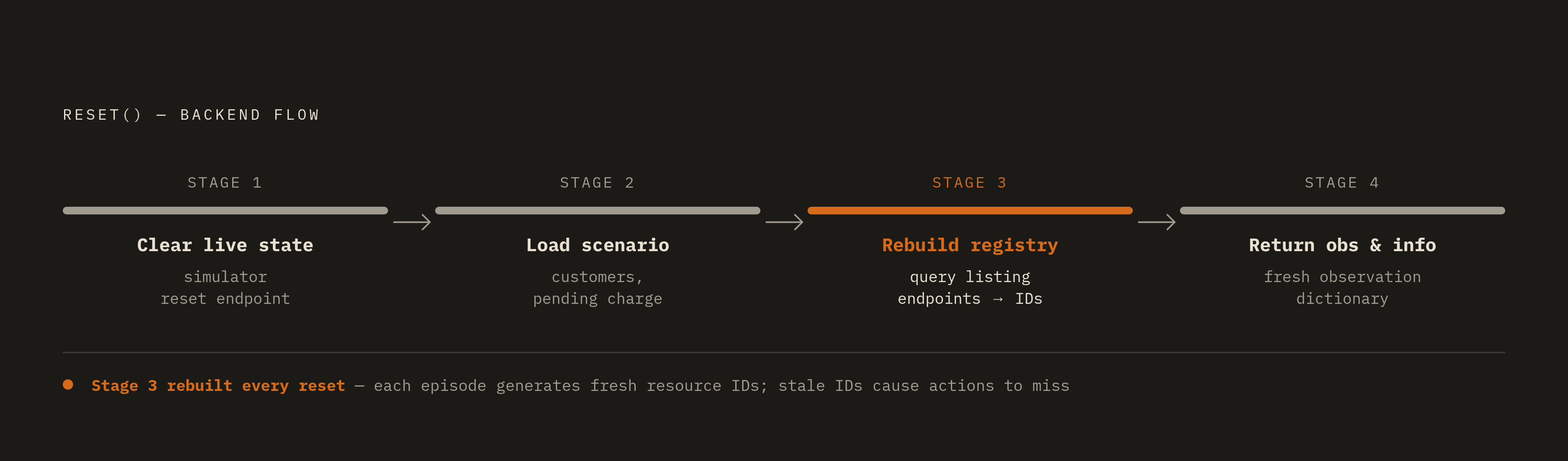
The backend flow has four stages in order. First, the wrapper calls the simulator’s reset endpoint or equivalent to clear live state. It then loads the selected scenario, such as two existing customers and a pending charge. Next, it queries listing endpoints to reconstruct the ID registry. Finally, it builds a fresh observation dictionary that matches observation_space and returns it with a fresh info dictionary.
The registry must be rebuilt on every reset because new episodes can generate fresh resource IDs even for the same scenario. Reusing old mappings points actions at stale resources. Each worker must also reset only its own namespace or container, so that restoring one episode cannot erase another worker’s world.
Implementing step() and encoding rewards from API response state
With reset establishing valid state and identifiers, step() can translate policy decisions into resource transitions. It decodes the action into an endpoint and parameters, resolves resource indices through the registry, and calls the simulator. The resource state after the call becomes the next observation. The wrapper then computes the reward, determines both boundary flags, and returns the five-tuple. This ordering makes the simulator’s transition, rather than the requested operation, the basis for scoring.
For the payment task, a reward could be +1 for a successfully captured charge and -1 for a failed or disputed charge. More generally, the pattern compares a task metric before and after the action, optionally adding efficiency shaping or invalid-action penalties. Invalid actions should not crash the episode. They should return the same observation values in a fresh object, a negative reward, and terminated=False, while external limits still govern truncation.
The info dictionary can keep the raw response, HTTP status, and decoded action without adding them to the policy’s observation. Responses such as a 409 conflict or a 404 for a deleted resource can then inform reward or boundary logic. Incremental checker runs catch observation-space violations while these branches are being implemented.
Episode termination semantics and truncation against an API lifecycle
A terminal API status is meaningful only relative to the task. A successful capture may end a capture task, but a task that includes refund behavior must let the agent take more actions after success. The task definition resolves that apparent conflict. terminated marks a natural end to the task, while truncated marks a stop caused by maximum steps, wall-clock timeouts, or resource budgets that have run out. For an open-ended service such as Slack, the builder must define a bounded goal, such as routing a support thread to resolution.
A payment can move from pending to succeeded through a webhook-driven event, so the simulator must either model that transition within step() or expose polling that advances state before reward calculation. FetchSandbox fires transition webhooks for Stripe and other supported APIs, requiring the wrapper to receive or poll for events between steps. That choice affects both reproducibility and episode timing. Controlled seeded scenarios also help limit how much episode length varies across parallel workers.
Fault injection as a first-class training signal, not an afterthought
A policy trained only on successful responses has no basis for learning recovery from production failures. Faults belong inside the training distribution. These failures include connection resets and delays, server errors such as 429 and 503 responses, and malformed bodies or missing fields. WireMock supports declarative delays, malformed responses, and connection resets. These capabilities illustrate why failure configuration should live in the simulator rather than a separate harness built around the policy.
For this architecture, the recommended integration is a constructor-level fault_config passed through to the simulator. Training can begin fault-free, establish a baseline, and then introduce latency, 503s, and 429s incrementally. The step definition must account for recovery. Correctly backing off and retrying after a 429 can be useful behavior despite no immediate resource change, so the wrapper must decide whether each round-trip is a step or a retry loop is one logical step.
Failure fidelity also requires more than a menu of error codes. Injected failures should reflect the target API’s observed distribution and sequencing. Canary runs provide evidence about error rates and retry behavior for that comparison.
Running parallel episodes at training throughput with isolated simulator state
Parallel execution makes state ownership an operational requirement. AsyncVectorEnv runs environments in parallel, while SyncVectorEnv runs them serially, but both require independent simulator state for each environment instance. A practical pattern gives each worker a namespace ID through its constructor. The simulator routes that worker’s calls to an isolated in-memory partition. Reset, scenario loading, actions, and fault configuration must all affect only that partition.
Isolation does not by itself control load. Gymnasium v1.4.0 adds max_concurrency to AsyncVectorEnv to cap simultaneous resets and steps, reducing oversubscription when workers issue HTTP requests together. Local simulator servers can also scale horizontally, with each server handling a subset of workers.
Reproducibility must survive that distribution of work. Each namespace needs its own random seeds for choosing scenarios and timing faults so that the same episode can be replayed. Before scaling, a single-worker checker run can catch shared-buffer reuse and space violations that would otherwise spread through rollout data. Concurrency should amplify valid trajectories.
Applying this architecture to specific commercial APIs and their fidelity requirements
Stripe’s vendor-native test mode provides a parallel API environment with test cards, simulated webhook events, and a transaction dashboard. It also offers up to five sandbox environments, with direct webhook triggering through the Stripe CLI. That gives payment flows a substantial testing foundation. Their pending-to-succeeded-or-failed transitions map naturally to categorical observations, and synchronous test flows can make termination deterministic.
Slack has a different lifecycle problem because messages can keep arriving with no end. Daily fidelity verification is the relevant methodology for Slack and Kalshi. PayPal adds a delivery distinction that the simulator must preserve, since its simulated webhook events are demonstrations independent of an app. PayPal retries failed deliveries up to 25 times over an extended period, making delivery and retry behavior part of the training model.
These differences change what fidelity must cover. Payment transitions, open-ended event flows, and webhook retries cannot be evaluated by response shape alone. The builder should inspect the simulator’s published fidelity score and verification coverage before committing to it as a training backend.
Connecting the wrapper to a training library and validating the full pipeline
The validation sequence begins with registration through gymnasium.register() so the environment can be instantiated by string ID. Creation through gymnasium.make() enables the passive checker. Run gymnasium.utils.env_checker.check_env(env) on a single instance before training. It exercises reset and step behavior, checks the space and return contracts, and surfaces determinism problems. Gymnasium v1.4.0 also checks for distinct observation and info objects, guarding against silent rollout-buffer overwrites.
Next, run a complete scripted episode from reset to natural termination and print the five-tuple at each step. Verify that dependent calls change observations plausibly and that rewards have the intended sign and magnitude. Repeat with moderate fault injection. The wrapper should handle 429s and 503s without raising exceptions and keep the episode boundaries as intended.
Finally, use a two-worker SyncVectorEnv and actions expected to produce different states to check that observations diverge without cross-worker interference. Identical results in that test warrant investigation for shared state. Once this sequence passes, connect the wrapper to Stable Baselines3, RLlib, or CleanRL according to algorithmic needs. A compatible interface makes the environment runnable, but validated state transitions make its training signal credible.