Worker Isolation Strategies for Vectorized Simulated API Environments When Episode State Is Mutable
Four isolation boundaries for mutable RL simulators, and when each one fits.
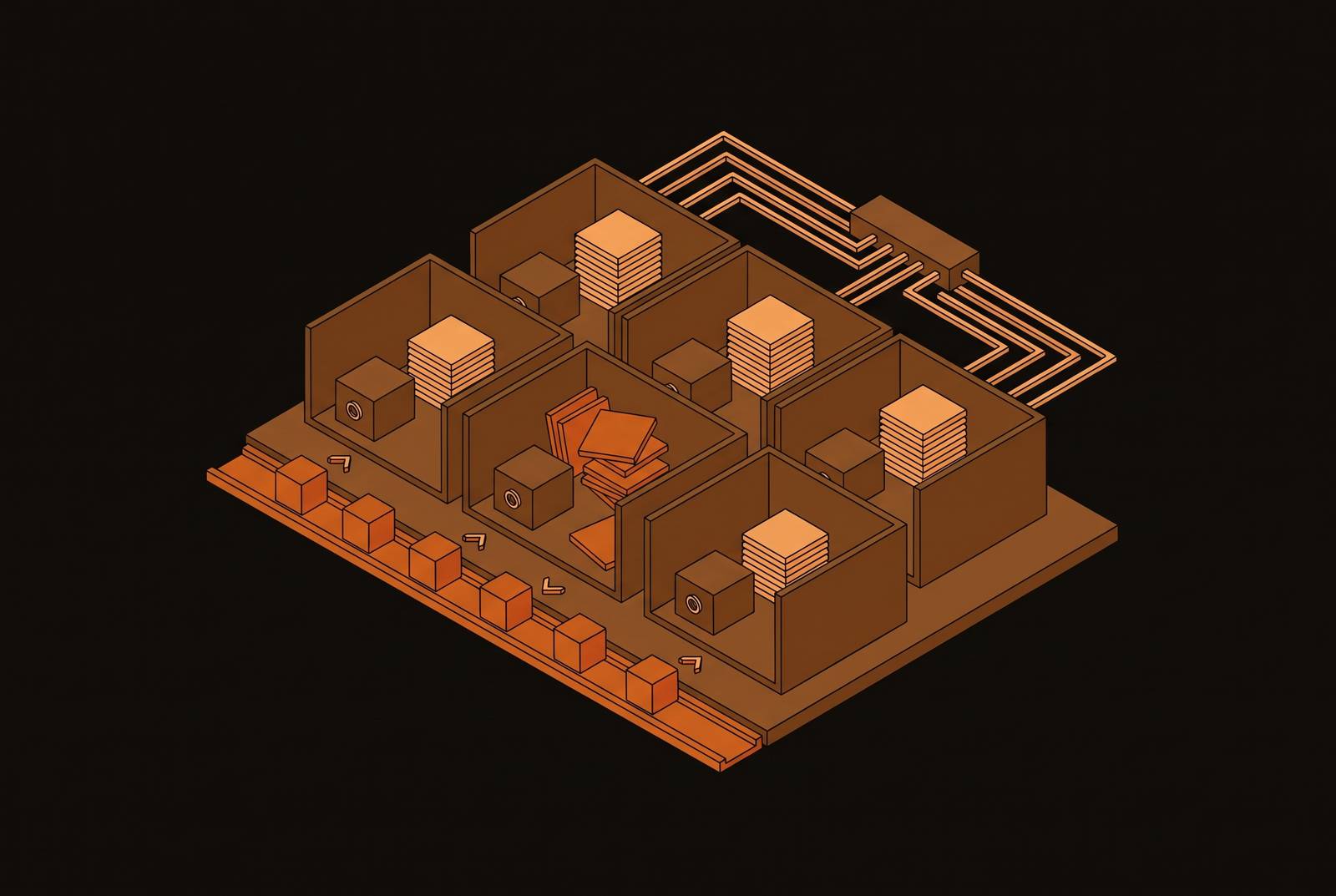
Tools for RL environments with mutable API state need two guarantees, namely a controlled starting state for every episode and a boundary that hides its writes from concurrent workers. Per-worker instances, snapshots, copy-on-write forks, and deployment lanes each put that boundary at a different layer. The right choice depends on concurrency, baseline reuse, and operational capacity, but every choice also requires verification against the real API.
Why parallel episode rollouts make shared simulator state an engineering liability
A rollout creates a user, and that user remains visible when the next episode begins. The next agent now encounters a resource its task assumed did not exist, so its result reflects another episode’s actions. Concurrent execution makes this harder to diagnose because neighboring workers can change state both before and during an episode. The failure is in the environment. Shared mutable state therefore turns rollout scheduling into an uncontrolled input to evaluation.
SimSAT frames stateful API-calling tasks around environments with both read and write APIs. That shift makes resource creation, order placement, and message posting part of the environment’s behavior. The Zetta ζ harness illustrates the corresponding infrastructure requirement by separating immutable model resources from per-slot episode state across heterogeneous CPUs and GPUs. Resetting or stepping one slot does not touch another. CI can fail in the same way when shared mock servers keep counters, stubs, or scenario state that changes how the next test starts.
What "isolation" actually means when episode state is mutable
Isolation has two distinct properties, and both are required. Isolation in space means that worker A’s mutations remain invisible to worker B throughout concurrent execution. Isolation in time means that a new episode starts from a defined baseline rather than the residue of the previous episode in its slot. A clean reset alone does not protect concurrent workers. Conversely, separate workers do not establish a controlled baseline unless their state is reset between episodes.
A stateless mock cannot meaningfully demonstrate these guarantees for mutable tasks because it returns fixed responses regardless of prior calls. It cannot model the transition from a 404 before resource creation to a 200 afterward. A stateful simulator can model that transition, but its episode scope must be explicit. The architecture must define where that scope begins and ends, whether at the process, container, or simulator state layer.
Per-worker simulator instances: the simplest boundary and when it is sufficient
With a dedicated simulator instance, each worker is the sole owner of its episode state. When that ownership includes all mutable state, cross-worker contamination is structurally excluded. This is the most direct baseline for comparing alternatives. Zetta’s Z-Infra layer illustrates the ownership principle through slots forked from a shared ModelTemplate, with reusable immutable resources but private mjData and episode state. Exclusive mutable state provides isolation while allowing read-only resources to be shared.
Full instance duplication, however, imposes memory and startup costs on every worker. Zetta’s separation of reusable model resources from private episode state shows why avoiding unnecessary duplication becomes valuable at scale. Per-worker instances work well when rollout counts are moderate, startup takes little time compared with the episode, and heterogeneous tasks have initial states that are hard to share. They also permit independent verification against the real API without interference from neighboring workers. Heavyweight instances become expensive at thousands of concurrent rollouts, where memory pressure can force eviction or throttling. A single richly pre-seeded environment is especially costly to duplicate repeatedly, which motivates restoring existing state.
Snapshot-and-restore: resetting to a known baseline without reinitializing from scratch
Snapshot-and-restore reuses an instance across sequential episodes by returning it to a saved baseline. When episodes need the same pre-seeded state, restoring a checkpoint avoids the work of initializing that state again. The restore belongs in episode setup, which is the equivalent of beforeEach. An episode that fails or aborts may never reach its cleanup step, whereas setup establishes the next episode’s baseline regardless of how its predecessor ended.
This provides temporal isolation. Two workers that restore and then mutate the same instance concurrently can still interfere unless a separate boundary scopes their access. The checkpoint must also represent a trustworthy, repeatable starting environment. If the simulator has drifted from the real API, every restore can reproduce the same inaccurate behavior. Snapshot-based reuse therefore depends on pre-seeded state that is continuously verified, with the baseline refreshed as the API changes.
Copy-on-write state forking: spatial isolation without full instance duplication
Copy-on-write, or CoW, shares a read-optimized base state while redirecting each worker’s mutations into a private layer. Workers can diverge without duplicating the full baseline. Zetta describes a related template-and-fork architecture in which a ModelTemplate retains the reusable read-only mjModel representation and initial simulation state. Each slot owns its mutable episode state, so resetting or stepping it leaves other slots untouched. Simulator-level state forking must take the environment’s storage model into account when keeping state separate in this way.
CoW is most attractive when concurrency is high, the baseline is expensive to replicate, and reads greatly outnumber writes. GET, LIST, and SEARCH operations can use the shared base, while POST, PUT, DELETE, and other mutations require private state. The advantage depends on the episode’s write pattern. Agents that mutate many resources early can cause write amplification that erodes the memory savings, so that behavior needs monitoring rather than an assumption that every rollout remains read-heavy.
Operating-system CoW through Unix fork() copies process memory but does not give a database-backed simulator a private database. Storage-layer forking must therefore be explicit where mutable state lives outside the process. Private layers also need garbage collection once their episodes have finished. These obligations make CoW a conditional choice for efficient concurrency.
Lane-scoped deployments: isolation through routing rather than forking
Lane-scoped deployments give each worker or worker group a unique identifier and route its requests to simulator state that only it owns. Routing and ownership of the namespace form the boundary. Cloudflare’s Worker Previews illustrate this structure in a web deployment context. Each Git branch receives an isolated environment with its own Durable Object namespace and Container application, keeping state changes, sessions, memory, and concurrent tests separate from other Previews and production. Running npx wrangler preview creates the branch’s namespace without explicit application-level forking logic.
For vectorized RL, the same structure assigns a lane ID at rollout start, using a namespace prefix, tenant scope, or separate simulator port. Every call is routed to lane-local storage, and the lane is reset or terminated when the episode ends. This removes the need to build state forks into the simulator. It does require a simulator that supports namespaced or tenanted state, as well as explicit lifecycle management. Storage and indexing overhead grow with concurrent lanes, and abandoned lanes accumulate stale state unless cleanup is managed.
How the filesystem-workspace pattern handles isolation for artifact-heavy episodes
Files, documents, and workbook artifacts can remain mutable outside the simulator’s state store. API state and these artifacts each need their own isolation. The Spreadsheet-RL paper describes Spreadsheet Gym assigning each trajectory a unique workspace identifier and a seeded workspace, confining file mutations to that trajectory’s directory. Its Appendix A.9 explains that filesystem isolation preserves batched asynchronous rollout scalability without a heavyweight environment process for every trajectory. A dedicated simulator can isolate API state while a per-rollout workspace isolates workbook artifacts, but both still need starting state and simulator behavior that can be trusted.
Fidelity and drift as the shared failure mode across all isolation strategies
A perfectly private environment can still return the wrong response schema, omit a newly required field, or use an obsolete error code. An agent trained against that environment gets false signal even when no other worker interferes. Determinism does not remove this risk, because deterministic simulators can faithfully repeat behavior that the real API no longer exhibits. The boundary must contain accurate state as well as private state.
Snapshots make this dependency particularly clear because each checkpoint preserves a point-in-time baseline. As the real API evolves, the checkpoint can remain internally consistent while becoming externally inaccurate. The engineering requirement is ongoing verification against the live API before each simulator release, with re-verification and new snapshots on API version changes. Published, version-controlled fidelity scores provide an auditable record of divergence. This turns simulator accuracy into an infrastructure property that can be examined independently of whether isolation works.
Fault injection and episode reproducibility as first-class isolation concerns
Fault configuration is part of episode state as well as simulator configuration. Simulated latency, 429 rate-limit responses, 503 service-unavailable responses, and dropped connections must stay within the episode intended to experience them. Otherwise, a fault-handling test can produce false negatives in a neighboring clean run while obscuring its own result. The sequence must also be controlled. A scenario in which the first request returns 503 with Retry-After and the second succeeds differs from one in which a payment commits but its response is dropped, requiring a safe retry.
A dedicated instance gets its local fault configuration before its episode starts. Snapshot-based execution must either restore fault configuration with the baseline or apply it after restoration and before execution, since restoration may overwrite it. With CoW, faults placed in the base template propagate to every fork, so episode-specific faults belong in private layers that support fault-state writes. Lanes attach fault configuration to lane-local scope and require routing to treat it as part of the episode’s state. A fixed, isolated fault sequence makes the fault scenario reproducible across runs and supports meaningful comparison between policy versions without neighboring workers changing the test conditions.
Choosing the right isolation boundary given scale, fidelity, and operational constraints
The practical choice starts with concurrency, episode homogeneity, and operational capacity. With low-to-moderate concurrency and heterogeneous episodes, per-worker instances give each worker its own state that can be checked on its own, with no shared mutable state to audit. This fits particularly demanding fidelity requirements. When many concurrent agents explore the same expensive pre-seeded world, CoW is a better fit if writes remain limited and the team can manage storage-aware forks and private-layer cleanup. The choice turns on how much work sharing the baseline saves compared with the work of managing divergence.
Sequential reuse calls for snapshot-and-restore in setup, paired with verification tied to the real API’s release cadence. For large-scale deployments with fixed simulator internals but controllable routing, lane-scoped namespacing avoids adding internal fork machinery, provided lane cleanup remains explicit. Artifact-producing tasks require an additional filesystem workspace boundary regardless of the API-state strategy. These choices can also be layered. A production RL pipeline can use CoW for concurrent rollout isolation, snapshots for episode resets, and lanes for separation between teams or experiments.
The final acceptance criterion is evidence of fidelity. Teams should treat simulator auditing as part of the same infrastructure discipline as process ownership, state forks, and routing scope. Published fidelity scores and verification against the real API make that discipline inspectable. Without them, a successful isolation test establishes only that workers cannot contaminate one another.
Sources
- Introducing Worker Previews: isolated preview environments for every change your agent makes
- Zetta $\zeta$: An Efficient Closed-Loop Embodied Harness for Self-Evolving Physical Intelligence
- Simulate to Generalize: Scaling Stateful Supervision for API-calling Agents using LLM World Models
- Simulate to Generalize: Scaling Stateful Supervision for API-calling Agents using LLM World Models
- Spreadsheet-RL: Advancing Large Language Model Agents on Realistic Spreadsheet Tasks via Reinforcement Learning